Teacher Spotlight: B.K.S. Iyengar
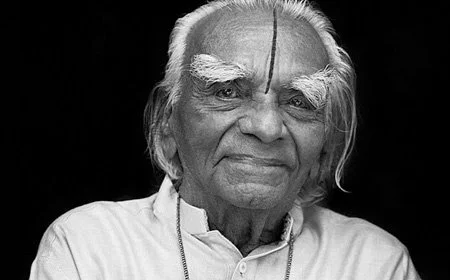
Today, with Iyengar yoga centres in nearly 80 countries around the world, B.K.S. Iyengar should be a household name to any modern yoga practitioner. Whether they know his name or not, it is no hyperbole to say that he has influenced nearly every yoga practitioner in the world. It is due to Yogacharya B.K.S. Iyengar’s sheer devotion that the term “alignment” became so important in describing and practicing yoga poses. It is also due to his influence and innovations that a wide array of yoga props such as blocks, straps, and bolsters are the norm in yoga studios everywhere. He kept “running” in his personal yoga practice from 1934 until 2014, when he left his body at the age of 95. It was his wish to spend his last breath in a yoga asana, and it seems that may have been granted as his mortal remains were in fact found in the practice room of the yoga institute that is dedicated to his wife. In preparation for writing this Teacher Spotlight on the man many know and refer to as Guruji, I read summaries and articles on his life, and revisited all that I have read and absorbed about him since I started my yoga practice just over 15 years ago. Like countless yoga students worldwide, it was his striking 1966 book “Light on Yoga” that really sparked my interest in him and the subject of yoga. “Light on Yoga” is more of an asana how-to manual than it is a deep dive on yoga philosophy, but if the latter is more your thing than I wholeheartedly recommend his delightful 2005 book “Light on Life.” It will be no small challenge to keep this article relatively short, as B.K.S. Iyengar’s life reached epic proportions, but I will do my best not to bore you with his endless accolades and instead try to paint a more personal picture of a man, a great yogi, who at 95 years of age even took the time to write back to a yoga baby like myself.
Bellur Krishnamachar Sundararaja Iyengar was born December 14th, 1918, in the tiny village of Bellur, Karnataka state, India. As he often points out when extolling the healing and transformative potential of yoga practice, before he began yoga practice he was weak and sickly, suffering tremendously due to illnesses like malaria, tuberculosis, and typhoid. It just so happens that in 1925 Iyengar’s father had arranged the marriage of his (very) young daughter Shrimati Ammagiriama to none other than Sri Tirumalai Krishnamacharya, one of the most influential yoga teachers of the twentieth-century and the supposed creator of the vinyasa yoga method. So it was some strange destiny that when Krishnamacharya finally met his much younger brother-in-law, he suggested Iyengar come with him to the Royal city of Mysore, to be initiated in yoga and heal from his illnesses. Iyengar took the invitation and the initiation in yoga, and started a lifelong relationship with his own Guruji. Adding “ji” as a suffix is an Indian way of adding more respect to the term “Guru,” or spiritual teacher. The direct and close teacher-student relationship between Iyengar and Krishnamacharya did not last long however, less than three years. Nonetheless Iyengar advanced quickly as a student, eventually becoming the star pupil of the Yoga Shala at the Mysore Palace and giving numerous yoga asana demonstrations for the Mysore Royal Family, including at one time for Paramahansa Yogananda. Thus one of Iyengar’s demonstrations caught the attention of a western-educated Indian surgeon, Dr. Gokhale, who could not believe his eyes. Dr. Gokhale would also be largely responsible for giving Iyengar an education in medical terminology which endowed him with the ability to communicate the physiological benefits of yoga to a modern, Western minded audience. This was in 1937, and with permission from the Guru, Dr. Gokhale helped Iyengar leave Mysore and move to Pune, where he had secured a teaching opportunity for the 19 year-old. Iyengar has described this moment as like being released from a tiger’s claws, as Krishnamacharya had a fierce reputation at that time. Despite having only a few dollars to his name, the young Iyengar had been freed as it were from his Guruji’s tiger grip, and from then on his prowess in the practice and reputation as a brilliant teacher began to grow.
Iyengar has had many famous students over his extraordinary career, such as Sri Jiddu Krishnamurti the Indian philosopher and spiritual savant. It was the celebrated violinist Yehudi Menuhin however who helped Iyengar reach the wider world by inviting him to teach in Europe. Eventually his European appearances led to teaching engagements in the United States and later in Canada. By the 2000s he was known worldwide. Today “Iyengar” is defined in the Oxford English Dictionary as “Noun: A type of Hatha Yoga focusing on the correct alignment of the body, making use of straps, wooden blocks, and other objects as aids in achieving the correct postures.” The use of props in yoga practice is actually something that can be traced back to ancient times, but Iyengar’s reinventions and emphasis on practicing with them to achieve the right alignment in yoga postures is truly the reason props are ever-present in studios around the world. Oddly enough though, no props are featured in his book “Light on Yoga” despite his demonstration of hundreds of asanas.
So I used this fact once to try and excuse myself when attempting to practice shoulderstand (Sarvāṅgāsana) in an Iyengar yoga class in the US. I was striking the pose, as we often do in Ashtanga practice, without any extra support. The class had been instructed to do the pose with multiple folded blankets placed on the mat precisely, but I had skipped that part and whipped up into it to see what would happen. I was swiftly called out and scolded, to which I came down to ask the teacher “how many blankets had Mr. Iyengar used for his Sarvāṅgāsana in Light on Yoga?”, to which she quickly retorted that Mr. Iyengar had been young and inexperienced when he had produced that behemoth,—he had since then learned better. I dutifully complied as I always do when taking an Iyengar yoga class. The staunch and strict style of Iyengar-classes can be sometimes off-putting, but Iyengar’s insistence and creativity in using external supports to better align students’ form in asana is also remarkable, it helps so many more people experience the joy of yoga.
Here is an excerpt from his book “Light on Life” concerning alignment:
“Seek balance of awareness in all positions by observing the differences on the right and left as well as the intensity of stretch from plane to plane, limb to limb, muscle to muscle, joint to joint, and from bottom to top, side to side, and back to front. Create equal stretch, equal stability, equal spacing, and equal intensity of movement. To bring a part of the body in correct alignment, you have to work with the whole body. You have to work with each and every part of the body. For each asana or pranayama, you have to know what the function or state of each area and each part of the body should be, whether active or passive, stable or mobile. When performing asanas, no part of the body should be idle, no part should be neglected. If you are stretching the right leg, for example, the left leg should not be forgotten. On the contrary you have to alert the left leg to remain stable. This complementary action frees up the right leg to move with ease. Extend where the body is not moving. If you perspire on one side, you should also evenly perspire on the other. When you perspire more on one side, you have not used the other portion fully. Perspiration should be even but not excessive.”
Although I have spent the past decade focusing on Ashtanga yoga practice and learning more about Krishnamacharya’s life and teachings, I will always remain an avid Iyengar yoga student. Feeling inspired after reading “Light on Life” for the first time and already teaching yoga classes myself for a few years, I emailed Mr. Iyengar in January of 2014, just seven months before he would leave “this earth planet.” Incredibly he wrote back to me four days later, acknowledging my request and encouraging me to continue in yoga practice. I had been trying to skip the line and come to Pune directly to learn from him, without going through the normal Iyengar association process. Alas there was no room for me that time, but I still feel happy to have connected with him personally even in such a small way.
➸ Over the years Mr. Iyengar has been featured in many books and documentaries, some of my favourite are: “Sparks of Divinity” complied by Noëlle Perez-Christiaens (the book was first published in a bilingual French/English edition entitled: “Etincelles de Divinite”), the memoir “First There Is A Mountain” written by Elizabeth Kadetsky, and the documentaries “Elighten Up!” directed by Kate Churchill, “Breath of The Gods” directed by Jan Schmidt-Garre, and “Sadhaka: The Yoga of BKS Iyengar” directed by Jake Clennell.
As a bonus, check out Jake’s mother Bobby Clennell’s fantastic animation of Mr. Iyengar “YOGA YANTRA” on YouTube: https://www.youtube.com/watch?v=VFbT9YgAMt4