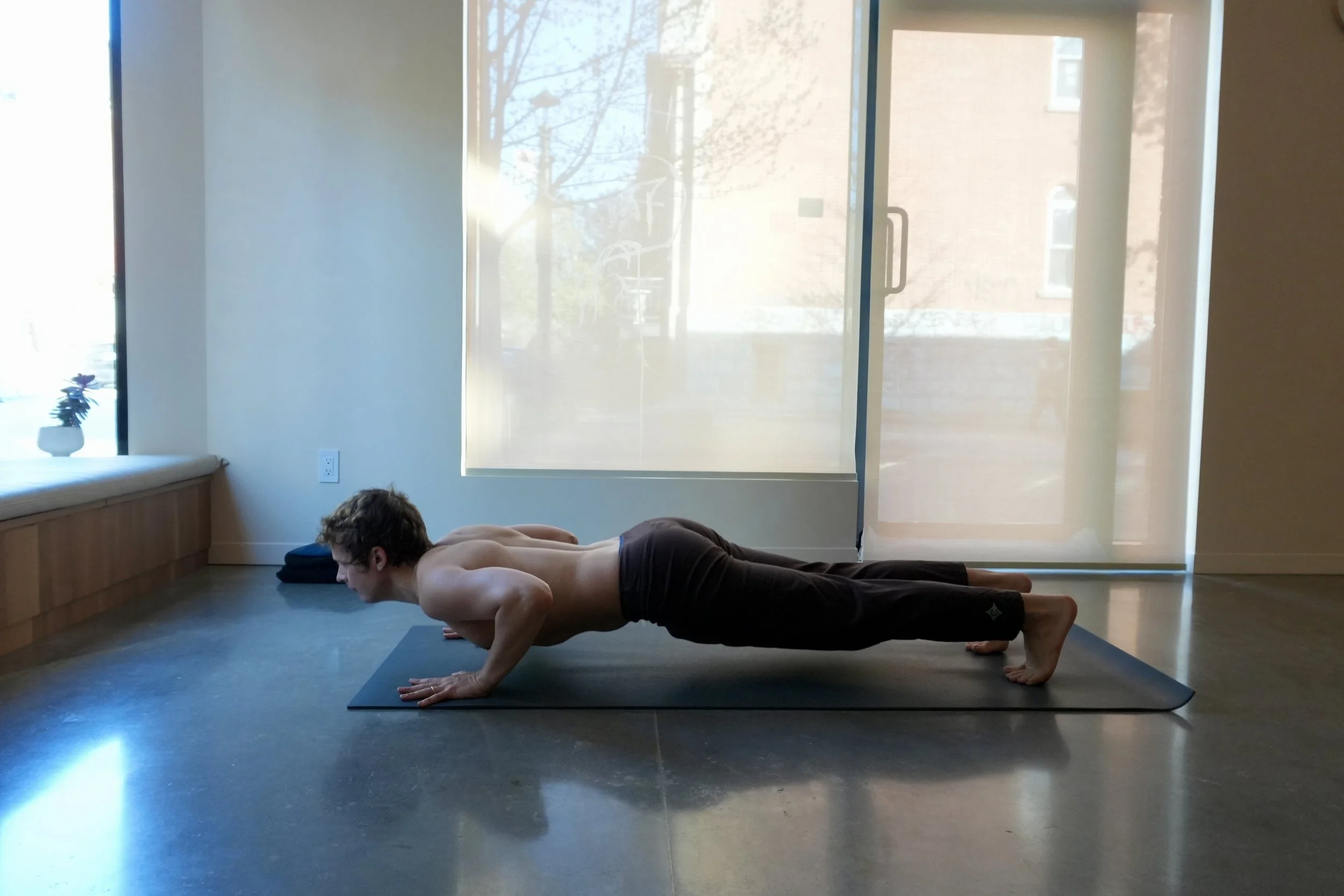
Aṣṭāṅga Vinyāsa Yoga
What is Ashtanga Yoga?
Aṣṭāṅga Vinyāsa is a particular style of yoga practice that originated in southern India about a century ago. However, the principles and philosophy of the practice stretches back aeons. Notably, the ancient Indian sage Patañjali’s treatise Yoga Sutra, written around the 2nd century BCE, figures prominently in Aṣṭāṅga Vinyāsa lore.
The name “Ashtanga” itself means “eight-limbs” and is a reference to Patañjali’s work, which contextualizes this practice. Vinyāsa, one of the most popular styles of yoga practiced today, was likely invented by the 20th-century yoga master Sri Tirumalai Krishnamacharya. Vinyāsa means to order things in a special way, linking movement with (ujjāyī) breathing, and implies a step-by-step process. One of Krishnamacharya’s most famous students was Pattabhi Jois, who popularized Aṣṭāṅga Vinyāsa internationally, and helped to create the vinyāsa sequences as they are known and practiced today.
The Aṣṭāṅga Vinyāsa yoga tradition includes 3 major categories of postures, subdivided into 6 complete sequences, known most commonly as:
The Primary Series
The Intermediate Series
Advanced or “Proficient” Series, which itself now consists of four individual series.
The Proficient grouping of postures is referred to variously as “Advanced A, B, C, and D” or “Third Series, Fourth Series, Fifth Series, and The Sixth Series.”
Every “Ashtangi” starts their practice with The Primary Series. Primary Series focuses on forward folding, and in yogic terms is predominately āpanic in nature. Even as they eventually learn the subsequent series, all practitioners of Aṣṭāṅga Vinyāsa continue to refine and practice this initial sequence. Sequences are often taught in the more common led-class style, where all students practice in unison and synchronization like a school of fish, but Mysore style classes are the preferred method for deeper learning.
Mysore Style
Mysore style is part of the Ashtanga yoga lineage. Students learn individually in a group setting, through one-on-one interactions with the presiding teacher. It is one way of learning and practicing Ashtanga Yoga. The other way is in the more popular guided class format.
Mysore style is an ideal way for the teacher to address your unique questions and concerns about the practice, which you learn to make your own, meeting your own circumstances compassionately. Every student in a Mysore room is focusing quietly on their own practice, at their own pace. For this reason, it becomes a personal self-guided practice that allows you to experience yoga for yourself with the support of a teacher and community.
Everyone starts by learning the sequence known as “The Primary Series”. The teacher will work with you directly, teach you the breathing and poses one at a time with the variations that are appropriate for where you are.
At the Mysore Program, you are free to enter the room and start your practice anytime during the class period. Please do not arrive for your practice later than 30 minutes before the class window closes, so that you can have at least half an hour of practice time.
The Mysore Program does also offer “Guided” classes where teachers are guiding students in unison through a practice.
History of Mysore Style
Mysore style refers to a type of group class which originated almost 100 years ago in the southern Indian city of Mysore, now called Mysuru.
The yoga master Sri Tirumalai Krishnamacharya taught yoga first at the Sanskrit College in Mysore, and later was given a wing of the Jaganmohan Palace by the Maharaja of Mysore to start the Yogaśālā, an independent yoga institution.
This is where the “Mysore style” tradition of independent practice in a group setting likely began, a method which is akin to the original tradition of yoga wisdom transmission, namely a 1:1 relationship between the teacher and the student. Years later, Krishnamacharya’s student Pattabhi Jois would teach this method to his family as well as scores of local and international students, which led to the spread of Mysore style programs around the world.
Traditionally, Mysore classes will be conducted in the early morning, six days a week, with no classes occurring on full and new moons, or on major holidays.
Sutra fourteen from the first section of Patañjali’s YogaSutra extols this approach, which the notable scholar Barbara Stoler Miller translates as:
“This practice is firmly grounded when it is performed for a long time without interruption and with zeal.”
To be clear, Patañjali was not advocating that the posture series of Aṣṭāṅga Vinyāsa be practiced in the aforementioned way—they hadn’t even been invented yet—but that the practice of stilling the mind must be continued enthusiastically over a long period of time in order for the practice to bear its fruits.